Handmade Percussions
In professional percussion, material selection is not marketing—it is an engineering decision that directly affects tone, durability and dimensional consistency.
Even a small addition of boron dramatically increases hardenability—the ability of steel to transform into high-strength martensite during controlled cooling.
The material is austenitized (~900–950 °C), formed and quenched in-die in a single thermomechanical sequence.
Tensile strengths above 1500 MPa allow thickness reduction without sacrificing structural integrity.
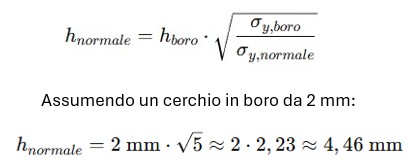
Young’s Modulus (≈ 210,000 MPa) is nearly identical for standard steel and boron steel. What changes dramatically is the yield strength (σᵧ).